
Eating Disorder & Anxiety Therapist in Silver Spring, MD

You hold yourself to standards most people around you don't even notice. From the outside it looks like drive. From the inside it feels more like a pressure that never fully lifts — in your work, in your body, in the mental space food takes up whether you want it to or not. You're not falling apart. You're just exhausted by the effort of holding everything together, and some part of you knows there's more available than this.
You've probably tried to work on this before. Maybe therapy, maybe recovery, maybe years of self-awareness and willpower applied to something that keeps coming back anyway. What you haven't found is someone who goes as deep as the problem actually is — who can hold both the ambition and the struggle without flattening either one.
A bit about me: Dr. Elizabeth Gordon, She/Her

I'm a licensed clinical psychologist with a doctorate from Yeshiva University, a master's from Harvard University in Human Development and Psychology, and a bachelor's from Johns Hopkins. I've spent over a decade working with eating disorders, body image, anxiety, and perfectionism across the full continuum of care: inpatient, partial hospitalization (PHP), intensive outpatient (IOP), and outpatient.
Most therapists who treat eating disorders have worked only with clients who've already stepped toward recovery. I've worked with people at every stage, including the most acute presentations and the high-functioning ones who don't think they qualify. That shapes everything: what I understand about ambivalence, about what keeps patterns running, and about what this work can actually do.
How I work as an anxiety and eating disorder therapist in Silver Spring, MD
My approach is integrative, drawing on CBT, psychodynamic therapy, and ACT. In practice that means I work on both the surface patterns — the thoughts, behaviors, and rules keeping you stuck — and on the deeper layer underneath them: where those patterns came from, what they've been protecting, and what it would take to not need them anymore.
In the room, I tend to be warm and direct in equal measure. I take the work seriously without being stiff about it. I'm genuinely curious about how people make sense of their lives, and I'm not easily rattled by the complicated or contradictory parts. Clients often describe the experience as feeling both held and challenged. A space where they can say the thing they've been circling around for years and have someone engage with it honestly, not just reflect it back. I care about this work, and I think that comes through.
If you want the fuller picture of how change actually happens in this work, I go into it here.
Who I work with
Most of my clients are high-achieving adults, professionals, academics, graduate students, people in demanding creative and relational fields — who are quietly carrying something the people around them can't see. Many are navigating eating disorders or disordered eating, body image concerns, anxiety, perfectionism, or some combination of all of these. Many don't have a formal diagnosis and aren't sure they need one. Some are early in recovery; some have been in recovery for years and feel like something is still unfinished. What they share is that surface-level approaches haven't been enough, and they're ready to go deeper.
What we work on together

Eating disorders & disordered eating
At any stage: early recovery, maintenance, or somewhere in between. Understanding what the eating disorder has been doing for you, not just what it's been doing to you, is where the lasting work happens.

Body image
The shame, the monitoring, the way appearance has become bound up with worth. This work draws on my full eating disorder background — body image is rarely just about the body.

Anxiety and perfectionism
The relentlessness, the inner critic, the standards that were supposed to protect you and started costing more than they're worth. The drive doesn't have to go away. The exhaustion can.

Depression
Especially the kind that doesn't look like sadness from the outside — that looks like going through the motions while feeling strangely far from your own life.
A bit more about me, your anxiety and eating disorder therapist in Silver Spring, MD
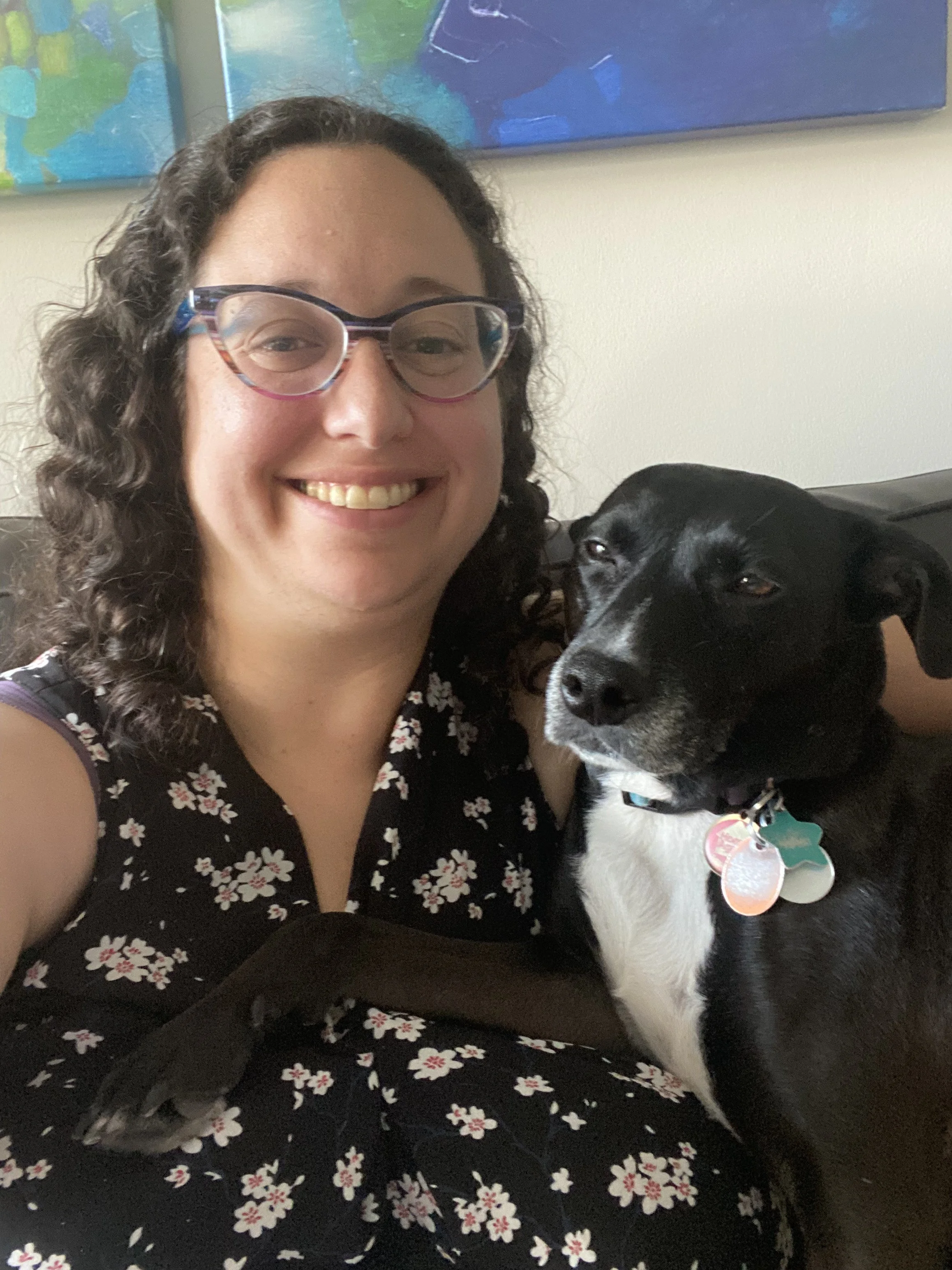
... and my friend, HarrietOutside of sessions, my rescue dog Harriet is a significant presence in my life and, during virtual sessions, occasionally in the room. She approaches mealtimes with an enthusiasm and commitment that I find genuinely admirable.
I grew up in Maryland, spent years in New York City, and am now back in Silver Spring. I love a good thriller, have recently been getting into historical fiction, and am always at least somewhat in the middle of learning a new language. Curiosity, honesty, and an appreciation for the small things that make life worth living are things I care about — and they find their way into the work.
Education & credentials
Doctor of Psychology (PsyD), School and Clinical Psychology — Ferkauf Graduate School of Psychology at Yeshiva University
Master of Education (Ed.M.), Human Development and Psychology — Harvard University
Bachelor of Arts (BA), Psychology — Johns Hopkins University
Licensed Psychologist — Maryland & New York
PsyPact provider #9653
Practice details
Sessions: $300 per session. Out-of-network; superbills provided for reimbursement.
Location: In-person in Silver Spring, MD (8609 Second Ave, Suite 404B). Virtual for clients in New York, Maryland, and all PsyPact states.
Getting started: Free 15-minute consultation. Reach out through the contact page.